

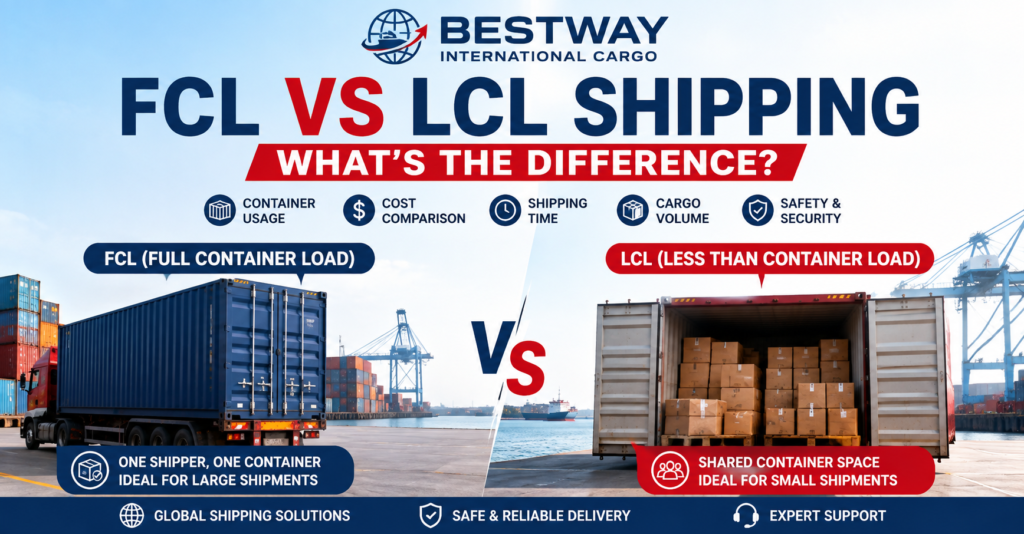
FCL vs LCL Shipping: What’s the Difference?
When shipping goods internationally by sea, one of the first decisions you may need to make is whether to use FCL vs LCL shipping. These two shipping methods are designed for different cargo volumes and business requirements.
FCL stands for Full Container Load, while LCL means Less than Container Load. Understanding the difference between FCL and LCL can help you choose a shipping option that matches your cargo size, budget, delivery requirements, and overall logistics plan.
At Bestway International Cargo, we help customers understand international sea freight options and select a suitable solution for their shipments.
What Is FCL Shipping?
FCL shipping, or Full Container Load shipping, means that one shipper uses an entire shipping container for their cargo.
The container does not necessarily have to be completely filled with goods. A business can choose FCL when it wants to reserve the full container for its shipment, even if there is some unused space.
FCL is commonly considered for large-volume shipments, commercial inventory, machinery, furniture, and other cargo that can efficiently occupy a significant portion of a container.
Benefits of FCL Shipping
FCL can offer several practical advantages for larger shipments:
- The entire container is allocated to one shipment
- Less handling between different customers’ cargo
- Suitable for large-volume shipments
- Useful for commercial inventory
- Can provide better space utilization for substantial cargo
- Cargo remains within the dedicated container during the main ocean journey
For businesses regularly moving large quantities of goods, FCL can be a convenient way to organize international sea transportation.
What Is LCL Shipping?
LCL shipping, or Less than Container Load shipping, is used when your cargo does not require an entire container.
Instead of paying for a full container, your goods share container space with cargo belonging to other shippers. The shipments are consolidated before being transported by sea.
LCL can be useful for businesses and individuals who have smaller quantities of cargo and do not need a complete container.
Benefits of LCL Shipping
LCL can be a practical option for smaller shipments because you do not need to reserve an entire container.
Potential advantages include:
- Suitable for smaller cargo volumes
- No need to fill a complete container
- Useful for businesses shipping smaller quantities
- Allows cargo consolidation
- Can be practical when a full container is unnecessary
The final cost and transit process depend on factors such as cargo volume, weight, route, origin, destination, handling, and applicable charges.
FCL vs LCL: What Is the Main Difference?
The biggest difference between FCL and LCL is how the container space is used.
With FCL, the container is dedicated to one shipper. With LCL, container space is shared among multiple shipments.
| Feature | FCL Shipping | LCL Shipping |
|---|---|---|
| Meaning | Full Container Load | Less than Container Load |
| Container use | Dedicated to one shipment | Shared with other shipments |
| Best suited for | Larger shipments | Smaller shipments |
| Cargo consolidation | Generally not required between shippers | Required |
| Handling | Usually fewer consolidation-related handling stages | More handling may be involved |
| Space | Entire container | Only required portion |
| Ideal for | Large commercial cargo | Smaller international shipments |
Is FCL Cheaper Than LCL?
There is no universal answer because the total shipping cost depends on the shipment and route.
For a relatively small shipment, LCL shipping may be more economical because you are paying for the space your cargo requires rather than reserving a complete container.
However, when cargo volume becomes large enough, FCL shipping can become more cost-effective on a per-unit or per-volume basis.
This means you should compare the complete shipping quotation rather than assuming that FCL or LCL is always cheaper.
Is FCL Faster Than LCL?
FCL can sometimes have a simpler transportation process because the container is dedicated to one shipment. LCL cargo generally needs consolidation with other shipments and may require additional handling at consolidation or deconsolidation facilities.
However, actual transit time depends on the shipping route, vessel schedule, port operations, customs clearance, cargo handling, and other logistics factors.
If delivery timing is important, ask your freight provider for the estimated transit schedule before booking.
When Should You Choose FCL Shipping?
FCL may be suitable when:
- You have a large quantity of cargo
- Your goods can efficiently use a substantial amount of container space
- You want a dedicated container for your shipment
- You are regularly importing or exporting commercial goods
- Your cargo requires specific container arrangements
- You want to minimize consolidation with other shipments
For large commercial shipments, FCL can make container planning much easier.
When Should You Choose LCL Shipping?
LCL may be a better option when:
- Your shipment is too small to justify a full container
- You are sending a limited quantity of commercial goods
- You want to share container space
- Your shipment volume does not require an entire container
- You are testing a new international market with smaller inventory quantities
LCL gives smaller shippers access to ocean transportation without requiring them to book a complete container.
FCL vs LCL for Businesses
For businesses, the choice between FCL and LCL should be based on more than cargo size.
Companies should consider inventory requirements, shipment frequency, budget, destination, packaging, delivery schedule, and the nature of their products.
For example, a company importing a large stock of products for a warehouse may find FCL more suitable. Another business importing a small batch of products may prefer LCL to avoid booking an entire container.
As your shipment volume changes, the most suitable shipping method can change as well.
FCL or LCL: Which One Is Better?
There is no single shipping method that is best for everyone.
FCL is generally worth considering for larger shipments, particularly when using a dedicated container makes logistical and financial sense.
LCL is generally suitable for smaller shipments where booking a full container would leave significant unused space.
The right decision depends on your cargo volume, weight, destination, budget, timeline, and shipping requirements.
How Bestway International Cargo Can Help
Choosing between FCL and LCL can be easier when you understand your actual cargo requirements.
Bestway International Cargo services in Karachi provides international cargo and sea freight solutions for businesses and individuals. Our team can help you evaluate your shipment details and understand whether FCL or LCL is more appropriate for your cargo.
Whether you are shipping commercial inventory, household goods, machinery, equipment, or other permitted cargo, selecting the right container solution can help make your international shipping process more organized.
Final Thoughts
The difference between FCL vs LCL shipping mainly comes down to container usage.
FCL provides a dedicated container for one shipper and is commonly considered for larger shipments. LCL allows smaller shipments to share container space with other cargo, making it a practical alternative when a full container is not required.
Before choosing either option, consider your cargo volume, weight, destination, budget, delivery requirements, and handling needs.
If you are unsure whether FCL or LCL is right for your shipment, Bestway International Cargo services in Lahore can help you understand your available sea freight options and plan your international cargo movement more effectively.